While we devoted the first half of our autumn 2025 trip to Italy mainly to continuing our Italian studies in Sestri Levante (after a few days of sightseeing in Genoa), our week in Bergamo marked the start of the second half of our trip, during which we planned to visit several cities in northern Lombardy to “try them on for size” as possible places to live when we move to Italy next year.
We first journeyed by train from Sestri Levante to Florence, where we spent two days meeting with our visa team from Smart Move Italy and taking care of some other formalities related to our move. While we were there, we stopped by the ABC School to give hugs to all our teachers from our Road Scholar trip last spring, and had dinner with one of the new friends whom we had met through an expat group on Facebook.

From Florence, we traveled on a high-speed train to Milan, covering the nearly 200-mile (322 km) distance in less than two hours. The next morning, we met with the principals of the Italian company in which we’ll be investing in connection with our visa, and then took a regional train that afternoon from Milan to Bergamo. It has been great to be able to get around the country so easily and quickly by train!
The weather turned cool and rainy for our first day in Bergamo, but we had plans to meet with up Kristine, another U.S. expat who is now a very knowledgeable Italian relocation specialist, for lunch and to pick her brain about the city. (Sadly, we forgot to take a picture with her, though!) We had walked through a light rain from our Airbnb apartment to the restaurant, but moments after we left there, the skies opened up and drenched us in a Texas-style thunderstorm.
Like Siena, Arezzo, Volterra, and many other Italian towns, Bergamo has a medieval-era, walled upper city (città alta), built on high ground for defensive purposes, in dramatic contrst to the far more modern and cosmopolitan lower city (città bassa) below it. The historic città alta is the highlight of the city for tourists, so the following day—this time, under clear skies—we met with Kate, a U.S. expat living in Bergamo, who had offered to show us around. She met us at the bottom of the funicular (inclined railway) that connects the upper and lower cities.
The car is staggered onto multiple levels to match the slope of the track.
Kate guided us through the old city, pointing out many of the sights, and then we had lunch at a popular focaccia spot, Il Fornaio (not related to the restaurant chain of the same name in the United States). The array of different focaccia varieties displayed in the front window was mouth-watering. And yes, it tasted just as good as it looked.
Once we were stuffed with delicious focaccia, Kate took us out to the edge of the old city, where we could view a portion of the ancient walls that still completely encircle the città alta. Known as the Venetian Walls because they were built by the Republic of Venice in 1561 to protect the city from enemy attacks, the 3 3/4 miles (approximately 6 km) of walls were so formidable that they never had to withstand an actual siege, which is one of the reasons they are still perfectly preserved today as a UNESCO World Heritage Site.
Kate left us to explore more of the upper city on our own. We headed back toward the city center to get a better look at the Basilica of Santa Maria Maggiore and the Piazza Vecchia, and then it was time for a gelato break.
Bergamo, with its surrounding valleys dotted with dairy farms, is the self-proclaimed “European capital of cheese“, producing dozens of varieties. At least nine types are EU-certified as DOP (Denominazione d’ Origine Protetta, or Protected Designation of Origin). The DOP label indicates that all production, from raw materials to aging, has taken place in a specific geographical area and using traditional methods, ensuring the cheese’s authenticity and quality.
Over the weekend of our stay in Bergamo, the industry group FORME held its tenth annual Cheese Valleys program. In the Piazza Vecchia, they were setting up a covered market dedicated to artisanal the region’s artisanal cheeses, with representative examples displayed under glass on throne-like chairs.
Back in the lower city that evening, we decided to try one of the several ramen restaurants around our Airbnb. The ramen was much better than my chopstick skills. After several losses of wet and slippery noodles and vegetables back into the bowl of broth, I finally gave up and traded the chopsticks for a fork before I perished from hunger.
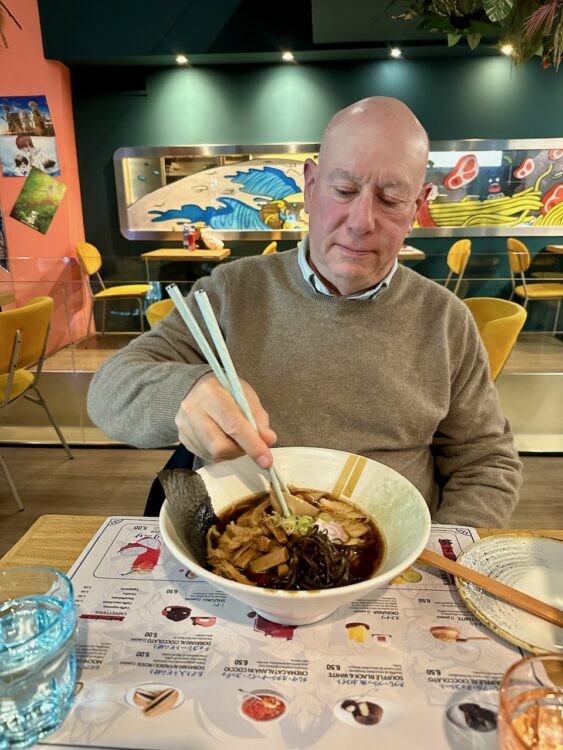
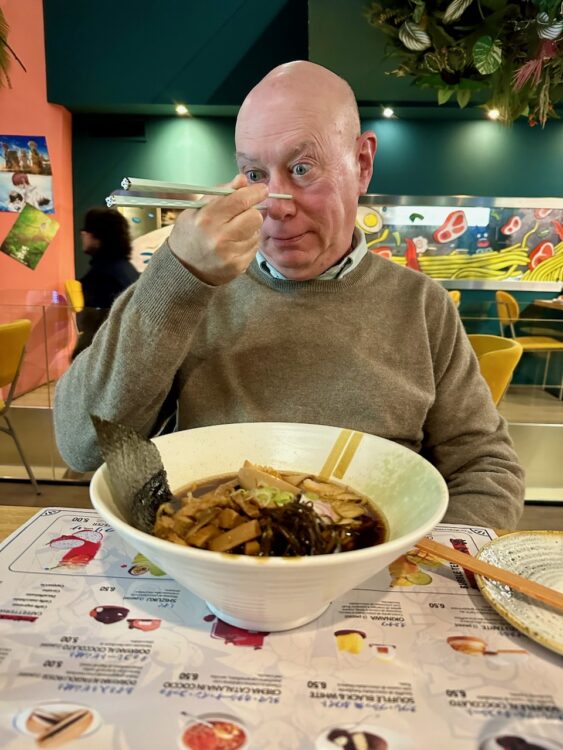
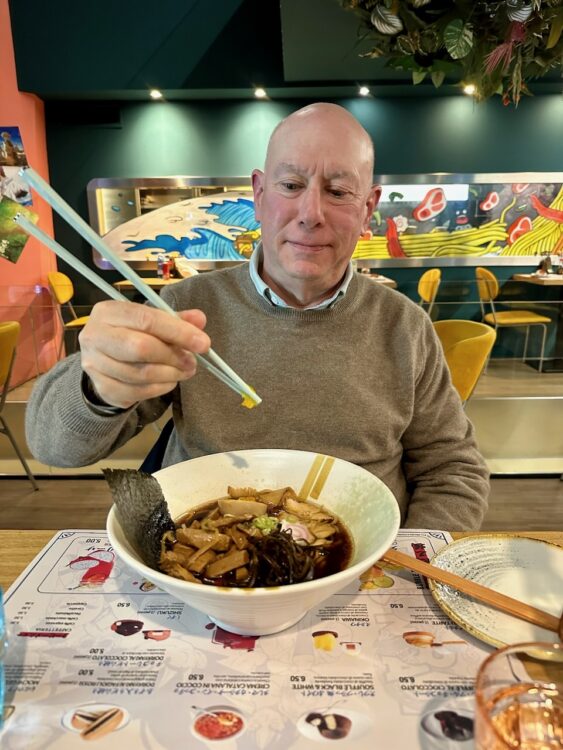
The next day, I walked to FORME’s “Cheese Park” pavilion, which turned out to be just down the street from our apartment, for a degustazione (tasting) of some of the delicious DOP cheeses. The pavilion was packed with locals enjoying the delicious cheeses and cured meats, all washed down with Italian wine, naturally.


On our final day in Bergamo, we returned to the città alta for a food tour with a local guide and a few other tourists. We sampled four bergamasque specialties: local wines, casoncelli alla bergamasca (a traditional fresh pasta stuffed with a mixture of sausage, mortadella, and cheese, served in a simple sauce of melted butter, sage, and crispy pancetta—yum!), polenta taragna (a rich version that combines corn flour and buckwheat with butter and local cheese), and stracciatella (in which ribbons of melted chocolate are drizzled into frozen vanilla gelato, causing the chocolate to solidify and break apart into many smaller pieces) at the gelateria where it was invented in 1961.
By the end of our enjoyable week in Bergamo, we had decided that while it was a lovely city with great amenities, and likely a great place to raise a family (interestingly enough, all four of the local expats we met in person and online were a few decades younger than us), we felt that it was a bit too modern, large and sprawling for us, and lacked some of the difficult-to-quantify-but-you-know-it-when-you-see-it Italian charm that we had experienced in other cities. Bergamo’s beautiful and dramatic città alta was the exception: it felt to us like an entirely different town, but housing there is expensive and difficult to find, the streets tend to be crowded with tourists, and everyday services like supermarkets are limited, which would require frequent trips on (and waiting in the queue for) the funicular to the città bassa unless we had a car.
So, leaving Bergamo, we repacked our bags, headed to the train station, and set our sights on our next destination, Lecco…but not before we walked one more time past this adorable little delivery truck for a wine store around the corner from our apartment!
Discover more from LANDMARK ADVENTURES
Subscribe to get the latest posts sent to your email.
Hello from drippy PNW, so good to read your adventures and the process you are utilizing. Arg, Texas style downpour. Looking forward to reading about the next community you are adventuring to. Wishing you great fun!
Thanks Jan!
Great adventures and thanks for sharing.
Hugs,
Lisa
Thanks for sharing with us!!!
[…] was the second town (after Bergamo) on our “where shall we live?” tour of northern Lombardy. Before our trip, we made a […]
[…] city of Como, on the southwestern tip of Lake Como, was the third stop (after Bergamo and Lecco) that we had planned on our tour of places to live in Italy. By this time, though, we […]